The Map That Shifted in the Rain
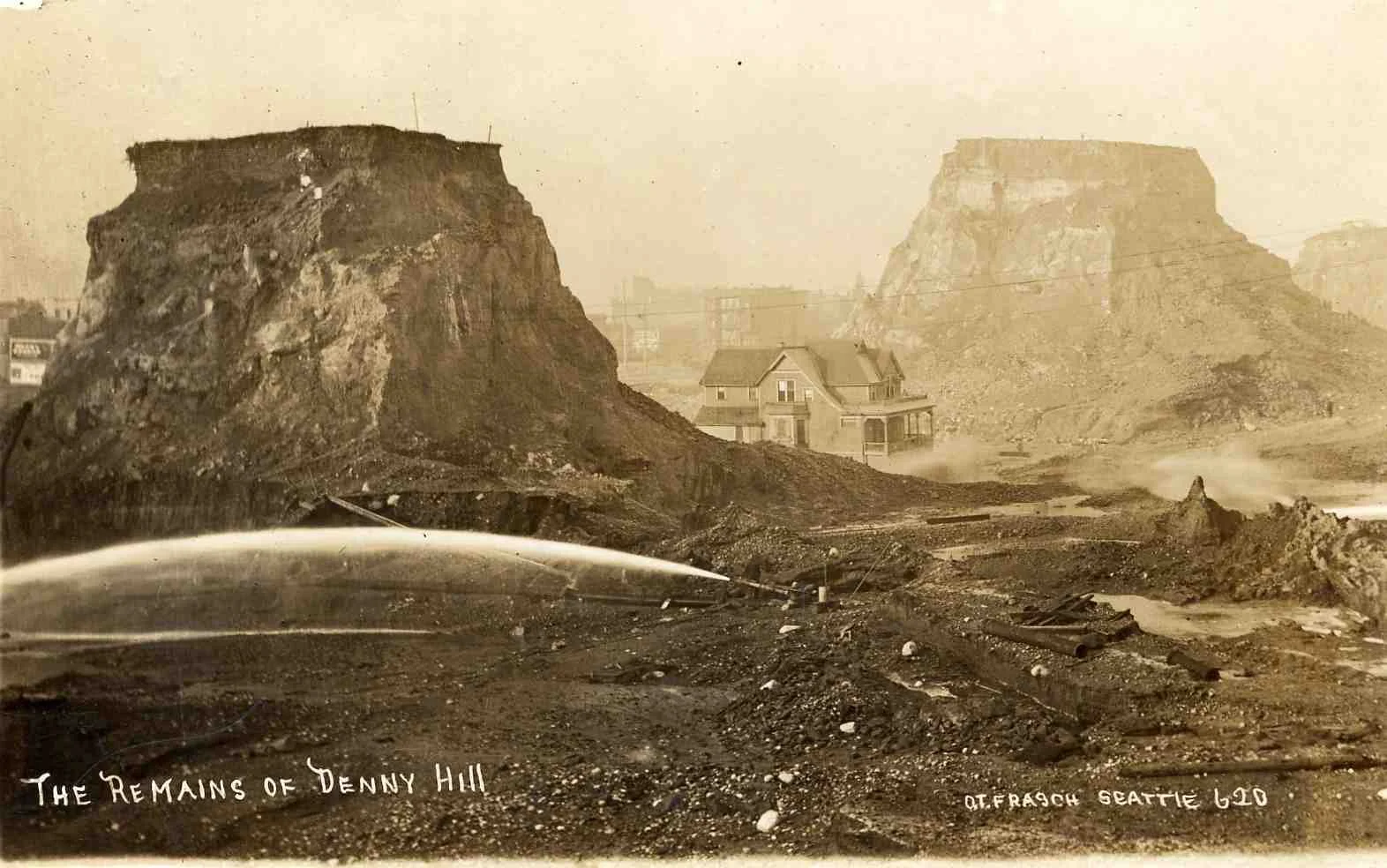
Seattle has always been a place where the ground moves long before the buildings do. The city’s earliest story is not one of architecture, but of geology made by hand. Pioneer Square sat on tidal flats that were filled and raised. Whole slopes were washed away in the Denny Regrade. Hills were carved down. Coastlines were remade. Streams were buried in pipes that still run beneath the streets. What looks like natural topography is, in many places, the residue of ambition.
The scale of the early landscape manipulation feels almost mythic now. Men with hoses liquefied hillsides and sent them flowing into Elliott Bay. Mountains disappeared overnight. Blocks lifted or lowered by stories. It was a callous kind of authorship. The city was not shaped. It was rearranged. Seattle’s first identity was not a design culture but a civil engineering project in constant motion.
The response to that violence was unusually gentle. The Olmsted Brothers arrived in the early 1900s and offered a counter-map: a city understood through promenades, ridgelines, shorelines, and park systems. Their plan wrapped Seattle in green and taught it to breathe again. You can still feel their hand in Seward Park, Greenlake, the UW campus, and the lakefront boulevards. It was the city’s first healing, a soft cloth placed on land rubbed raw.
But by mid-century, a harder imagination returned. The postwar era carved deep into the city again. The Alaskan Way Viaduct rose in 1953 like a concrete lid over the shoreline, severing the city’s cultural relationship with the water. Then I-5 arrived and cut the city open from north to south. A trench replaced the old spine between Downtown and Capitol Hill, destroying the Cascade neighborhood and displacing many in the International District. Seattle embraced mobility and speed, believing that cars would define its future. The 1962 World’s Fair added its neon optimism, but it also closed the chapter on the pastoral century. The city decided it wanted to be modern, and Modernity came with wounds.
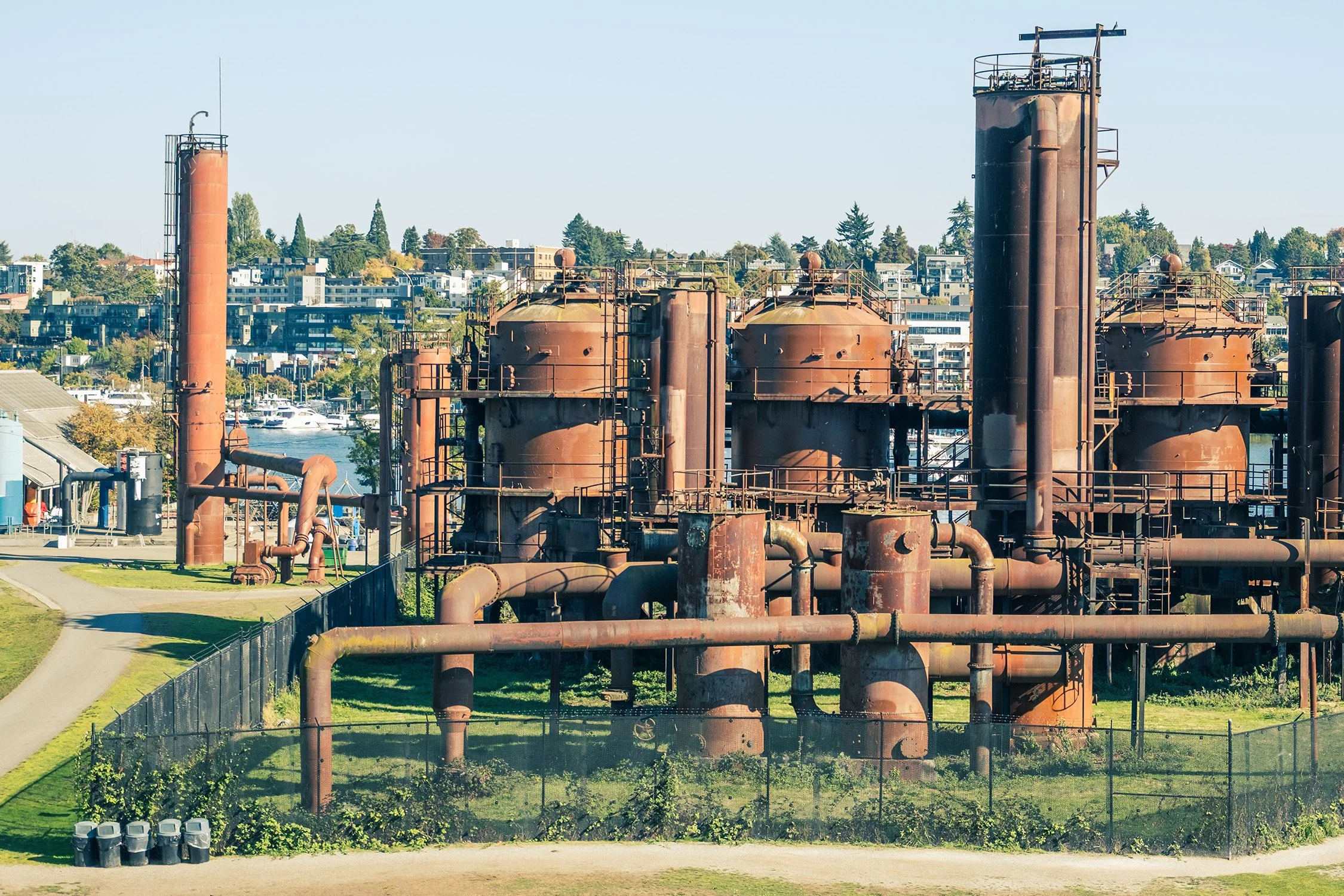
It did not take long for a new generation to recoil. The 1970s began with experiments in redemption. Freeway Park tried to cover the I-5 scar with terraces of concrete and water. Gas Works Park transformed a contaminated industrial site into a place of play and memory. Victor Steinbrueck helped design the Space Needle, then immediately turned toward preservation, leading the fight to save Pike Place Market from demolition. This was the second era of healing. Healing the land. Healing the skyline. Healing the city’s sense of itself.
After this burst of civic imagination, the 1980s and 1990s grew strangely quiet. The economy faltered. Tech had not yet defined anything. Seattle did not build big. Instead, the city retreated into houses and cabins, into interior rooms lit by Doug fir. This was the decade when the Pacific Northwest domestic imagination matured. An aesthetic based on assembling industrial fragments into lyrical structures hidden in forests and on mountain edges took root. It was as if the city was taking a long breath.
Then the 2000s arrived and shook the stillness loose. Gehry’s EMP crashed onto the Seattle Center campus in 2000. OMA’s Public Library followed in 2004, a crystalline essay on architecture as diagram. These buildings were aggressively not of Seattle. Weiss/Manfredi’s Olympic Sculpture Park opened in 2007, slicing its way from the city down to the water, was and continues to be the most successful intervention from without, masterfully stitching Belltown to the Sound and using an imported, formal language to allow for encounters with art, foliage, and water in a way that felt instantly of its place and time. These buildings pulled Seattle into a wider world. They ended the regional inwardness and reopened the city to global imagination.
But the true shift came when the viaduct came down and the waterfront finally re-entered the life of the city. Friends of the Waterfront formed in 2012 to shepherd the long, intricate process of reclaiming the edge. By the 2020s, Overlook Walk and the new promenade turned the old industrial corridor into a civic stage. Seattle remembered the water again. The map changed shape. A view that had been held at arm’s length for decades opened into a gentle slope.
If the last century has been a cycle of carving and healing, the question now is what remains unfinished. The answer is already forming.
The lid over I-5 is the next essential act. Reconnecting Capitol Hill to Downtown would complete the long arc that began when the viaduct fell. It would stitch the urban core into a continuous field of public space and activity, running from the hilltops to the water. It would give Seattle a civic center again, something it has quietly lacked for half a century.
Housing is the second frontier. Seattle debates zoning and planning with great intensity, but these discussions will not solve the deeper question: who is the city for, and what does it want to look like? New housing types are needed. New identities. Mid-rise blocks that feel rooted. Neighborhoods near light rail stations that actually become gathering places instead of spreadsheets. A design language that belongs to now, not to the 1990s industrial aesthetic or the early 2000s glass.
And beneath all this, the new light rail lines are reshaping the map again. Each new station creates a node, a potential district, a small gravitational pull. These nodes need architecture that carries dignity and character. Not corporate sameness. Not panic-driven density. Something that brings people together. Something that allows communities to see themselves reflected.
Seattle has spent a century correcting the consequences of its own ambition. The early hills were washed away. The parks softened the blow. The viaduct cut through the city. The waterfront healed the wound. Now the city stands on a threshold. The next map will not be drawn by machines or by mega-projects alone. It will be drawn by housing, by neighborhoods, by light, by the spaces between buildings, by whoever is brave enough to imagine a more cohesive identity.
Seattle will redraw itself again. It always does. But this time, the ground does not need to be moved. Only the vision does.